
- About
- Programs
- Research
- Campus Life
- Career Services
- Admissions
- News & Events
- Alumni











Governance & Quality Assurance


GOVERNANCE SYSTEM AT CÉSAR RITZ COLLEGES
Governance & Quality Assurance
Shared Governance
The César Ritz Colleges governance system reflects a structured and inclusive approach, enabling both internal and external stakeholders to actively contribute to institutional decision-making. This model emphasizes quality assurance and continuous improvement, ensuring that academic standards remain high and relevant. Alumni, industry partners, students, faculty, and staff are formally represented in governance processes, ensuring that diverse perspectives inform decisions that impact the institution.
To further strengthen institutional integrity and provide a mechanism for independent oversight, the Supervisory Committee delegates governance responsibilities to the Academic and Operations Boards. The Academic Board plays a central role in quality assurance and the integrity of the institution’s educational provision. It oversees academic policy, academic administration, and the educational process, ensuring that intended learning outcomes are consistently achieved. César Ritz Colleges is a member of Swiss Education Group.
- Swiss Education Group Board
The Swiss Education Group Board is responsible for the efficient, financially viable, and compliant conduct of the institution’s business.
The purpose is to give the school community a clear sense of the objectives the school is striving to achieve, how the Board intends to achieve them, and how success will be measured.
- External Advisory Board
- Academic Committee
The Academic Committee at César Ritz Colleges is responsible for ensuring the quality, relevance, and integrity of all academic programmes.
- It oversees the full programme lifecycle—from design and approval to ongoing monitoring and review—ensuring that courses are rigorous, coherent, and aligned with both regulatory standards and industry expectations.
- It evaluates programme performance using data and stakeholder feedback, guides curriculum development and innovation, and ensures that academic policies and practices are consistently applied.
- It also safeguards academic standards, supports quality assurance processes, and promotes continuous improvement to ensure that all programmes remain intellectually robust, industry-relevant, and aligned with the College’s mission.
- Governance Structure and Reporting Line
- Organizational chart


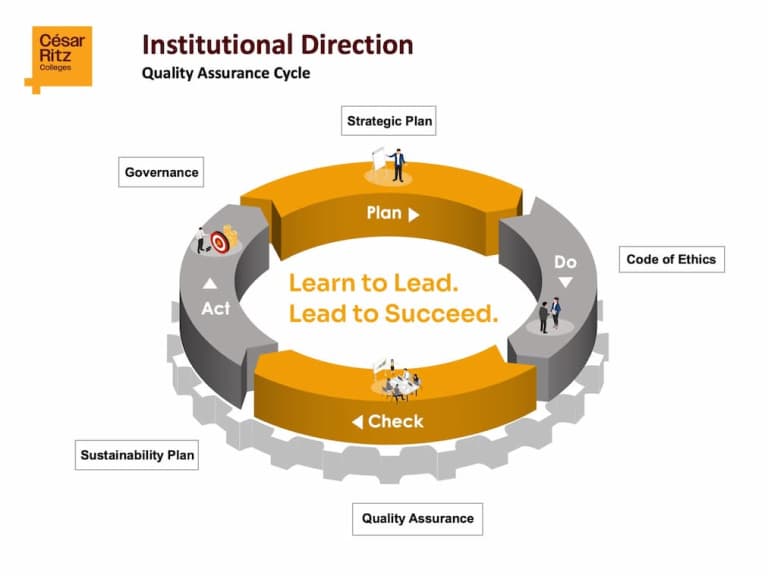
The Institutional Direction is guided by a continuous improvement approach based on the Plan–Do–Check–Act (PDCA) cycle. This framework ensures that strategic priorities are clearly defined, implemented, reviewed, and refined in a systematic way.
The cycle is structured as follows:
- Plan: Establishes institutional objectives and defines how they will be achieved.
- Do: Focuses on implementing these priorities through policies, processes, and academic and operational activities.
- Check: Evaluates progress and outcomes to measure effectiveness and impact.
- Act: Ensures continuous improvement by adjusting strategies and integrating lessons learned into future planning cycles.
Together, this structured and disciplined approach forms the backbone of quality assurance, ensuring that institutional priorities are systematically implemented, rigorously evaluated, and continuously enhanced.